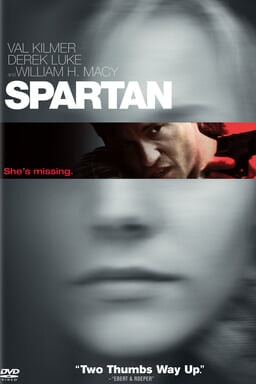
Now available on DVD and Video, film fans can add the political thriller, Spartan, (“a great movie” – Ebert & Roeper) to their film libraries! Preview the DVD extras, including a commentary by Val Kilmer, plus check out a Spartan image gallery, trailers, digital downloads, an interview with writer/director David Mamet and more. Spartan stars Val Kilmer, Derek Luke, William H. Macy and Ed O’Neill.

Starring Val Kilmer as Robert Scott, with Derek Luke, William H. Macy and Ed O'Neill

"Two Thumbs Way Up." Ebert and Roeper
She's missing.
Expect the unexpected when Spartan, the political thriller Ebert & Roeper call "a great movie," comes to video and DVD from Warner Home Video.
FBI. CIA. Secret Service. Black Ops. Robert Scott is all of these. And none of these.
Val Kilmer plays Scott, an off-the-books special-ops agent, whose newest assignment is to find the possibly kidnapped daughter of a high government official before the story leaks.
That assignment provides the frame to which filmmaker David Mamet adds gripping suspense, bold twists, his trademark flair for dialogue, and the acting of a superb ensemble.
With "two thumbs way up" from Ebert & Roeper, The New York Times says, Spartan "manages the difficult trick of being both logically meticulous and genuinely surprising." And according to The Washington Post, it is "charged with brilliance."
Spartan's extra DVD features include a commentary by Val Kilmer.
Rating: Rated R for Violence and Language
Aspect Ratio: Original Aspect Ratio - 2.40, Widescreen [16:9 Transfer]
Subtitles: English, Français, Español
Sound Quality: English: Dolby Surround 5.1


Visit the Official Spartan site

Own it on DVD
Now available on DVD and Video
MAMET INTERVIEW:
Q. Did you have an inspiration for this film?
A. I wrote the script, then I read a book called Inside Delta Force by a wonderful writer named Eric Haney who was involved with Delta Force from its beginning. I called him and said "I’m doing this film, would you like to come out and be a technical advisor?" And he said, "Absolutely!" to my great delight and to the inestimable impact on the film.
Q. What does our hero do?
A. Our hero in this movie is in charge of getting the girl back. The girl’s been kidnapped, and our hero has to get her back. And so, that being the case, it’s a mythological story, not unlike that of The Searchers or not unlike Shrek for that matter. It’s not unlike The Princess Bride where the princess has been kidnapped, and our hero’s got to get her back. It falls very directly into that genre which in one incarnation is called myth and in another incarnation, it’s called fairy tale.
Q. In fairytales, the hero is often presented with a series of challenges. What are the challenges for (Scott) this hero?
A. First off, he’s put on the wrong track. Then his superiors lie to him. And then when he finds out that the girl is not dead but is indeed alive, he has to find out why. And he has to find out who took her and then has to decide what he has to do to get her back. Which is what happens in the second act of this movie, which is what happens in the second act of the fairy tale. It’s the process Joseph Campbell calls "In the belly of the beast," when everything is in a state of confusion. And so there will be problems in the second act to get the hero back to the place he was at in the beginning of the first act...to help him reclarify the problem in its new form so that he can – just like Jonah – be spewed out of the belly of the whale, and cry forth against Nineveh, that great city.
Q. The script makes a continual distinction between thought and action with regards to Scott - As soon as he puts on his thinking cap he becomes disposable. This is also when he becomes a hero. Is there a struggle in that for him?
A. Sure. He says it himself. Someone says "Who are you?" at one point in one version of the script. He says, "I’m a thug who looked in the mirror." Because he’s a guy who’s been given various tasks and has been told if he stops thinking and simply follows these tasks, he will be rewarded and accepted into this elite warrior class. But he must never question the rectitude of his superiors or the worth of the tasks. And he’s put in a position where he has to question them and has to redefine himself as a warrior. Q. What about his relationship with Curtis? In a sense is he the greater hero who leads Scott?
A. I don’t know. Curtis is the protégé character who is generally depicted in comedies as one of the mechanicals of a low order – the comic relief. But in this myth he stands for perhaps the conscience of the hero, because he’s so new to this warrior cast that he keeps asking the questions that have been eradicated from the hero’s conscience. Why are we doing this? What does it mean? Are we on the right path?
Q. Is there a subtext in this movie about power and manipulation? What people will do for power – was this a theme in your writing?
A. Well I don’t think that’s a subtext, I think it’s very much a theme of the film. That our hero has to realize that he’s become what he beheld, and that in his own quest for personal power, he has put his conscience on hold to serve those whom he’s elected to believe. And so he’s become just like them. And when the second character, Curtis, dies, it is very truly the death of his conscience. It’s what alcoholics say - they’ve hit bottom. They can’t get any lower than that.
Q. Is this also the rebirth of Scott’s conscience?
A. Absolutely, because it has died, and that shocks him. That’s the point when he says, "I’ve got two choices - reform or die."
Q. What is the difference for you in the process of writing vs. directing a film?
A. [They’re both] about telling stories. And the tools at your disposal when you’re writing a film are a pencil and paper, and the tools at your disposal when you’re directing a film are the myriad aspects of film construction. You know, the sets and the costumes and the editorial process and the music. And you go from the most solitary of occupations – writing – to absolutely the most communal of occupations – filmmaking.
Q. You work with a lot of the same actors, for example, in this film you work with Macy and O’Neill…why did you cast them?
A. I cast Macy cause he’s owed me $2,700 since 1970. And I keep thinking that if I employ him - as I’ve been fortunate enough to do for thirty years - that maybe, he’ll come to his senses and pay me back.
Q. What about Ed O’Neill?
A. Oh, I love Ed O’Neill. He’s a great, great actor. Most of us, or I guess the ones who you’re referring to, go back to Chicago in the seventies where we – Macy and I – founded a theatre company in Chicago in 1971. Ed O’Neill and I started working together in the mid-seventies in Chicago. Five or six people in this movie go back thirty years.
Q. You haven’t worked with Val Kilmer before, why did you cast him?
A. I love him. I have always adored his work. He wanted to do the film, and I wanted to work with him. He’s a complete Huckleberry.
Q. Is there a characteristic or something about his personna that lends itself to portraying Scott’s character?
A. Yes. Scott has to deal with his inner nature. He has to in fact become integrated as a human being, and he lost a certain amount of pain because he suppressed his conscience. Val has to deal with a similar problem, in that he’s a Valley Girl. And so you see how he’s a big hulk of a man that’s a Valley Girl so trapped in the body of this big hulking guy. So he has to deal with that. You know - shoes, boys, clothes, good times, surfing…that kind of stuff.
Q. What about Derek Luke?
A. Derek Luke is not a Valley Girl. I saw Derek in Antwone Fisher, and was stunned by his performance. Sent the script to him. He said, "I would love to play your role. It’s a good character." So here we are. Q. Kristen Bell, how did you cast her?
A. She just came in and read, and it was one of those instances where I had saw several young women who were spectacular. But then I saw Kristen. It was one of those instances where she just demanded the part. In addition to being very talented and a lovely young woman, she was just tough. And so the point or the trick of the movie is that we spend eight reels hearing that the president’s daughter is this perfect person. She’s always pictured with curls and flowing hair, you know kind of a misshapen girl at Vasser, and you get there and she’s been imprisoned in a brothel, and she’s covered in toxic scum and is cursing like a banshee and has been vastly abused. And so that person has great toughness about her. And she’s a terrific actress.

Robert Scott (VAL KILMER) is a career military officer working in a highly secretive special operations force. A man hardened by years of brutal service, he is respected by his peers and elders in the world of espionage.
When Scott is recruited to find Laura Newton (KRISTEN BELL), the daughter of a high-ranking government official, he is paired with novice Curtis (DEREK LUKE), who becomes his protégé. Working with a special task force comprised of Presidential Advisors, the Secret Service, FBI and CIA, Scott and Derek stumble upon a white slavery ring, which may have some connection to Laura’s disappearance.
As the story unfolds, the straightforward search-and-rescue mission becomes complicated by the political ambitions of those in high places – like Stoddard (WILLIAM H. MACY), a political operative who may know more than he’s telling about the clandestine circumstances surrounding Laura’s abduction. Scott and Curtis are at the brink of tracking Laura’s whereabouts when the mission comes to an abrupt conclusion, with the media issuing reports of the girl’s death.
Scott returns to the quiet life of landowner in a rural location and awaits his next assignment in relative peace. But Curtis can’t rest. In his naiveté, he seeks out Scott to confide his belief that Laura is in fact alive. If she is, their continued unofficial investigation will put them as well as Laura at the center of a dangerous conspiracy that reaches the highest levels.
Franchise Pictures presents Spartan, a political thriller written and directed by DAVID MAMET and starring VAL KILMER, DEREK LUKE, ED O’NEILL and WILLIAM H. MACY. Spartan is produced by ART LINSON, MOSHE DIAMANT and ELIE SAMAHA, and executive produced by FRANK HUBNER. The director of photography is JUAN RUIZ ANCHIA; the production designer is GEMMA JACKSON; and the editor BARBARA TULLIVER.
Spartan will distributed by Warner Bros. Pictures, a Warner Bros. Entertainment Company.

Warner Bros. Sitemap -- See what we have to offer!

JavaScript is required to visit this site.
Please turn JavaScript on in your browser to view this site.